The short answer
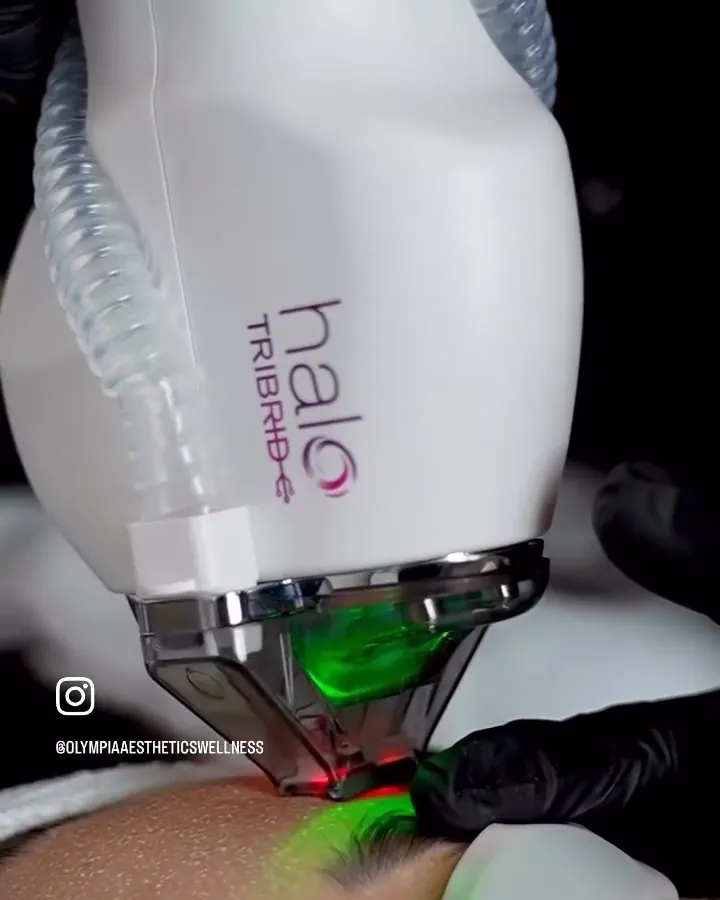
HALO TRIBRID is a Sciton fractional laser with three independently set wavelengths: 2940 nm for surface texture, 1927 nm for brown pigment and 1470 nm for the deeper dermis. It is used for sun damage, lines and scars, often in one session. Near Tampa, it is available at Olympia Aesthetics & Wellness in Palm Harbor, about 24 miles from downtown, for $2,550 per full treatment. Downtime runs a day or two to about a week.
What each wavelength does on its own
A wavelength decides how a laser behaves in skin: how far the energy travels, and whether it removes tissue or only heats it. HALO TRIBRID has three. Each is already familiar at our practice, as a treatment by itself or as half of another, so take them one at a time.
All three are fractional. They treat microscopic columns and leave untouched skin between them. A 2012 review of fractional laser resurfacing explains the trade: treat only a fraction of the skin, and the healthy skin around each column speeds the repair.
2940 nm: the surface
This is the ablative one. It vaporizes microscopic points of the top layer, which is how rough texture, enlarged-looking pores and surface sun damage get replaced with new skin. Sciton lists it as adjustable from 20 to 150 microns in TRIBRID. By itself, 2940 nm is the erbium wavelength behind our ProFractional, Contour TRL and laser peel treatments.
1927 nm: brown pigment and brightness
Non-ablative. It heats tiny columns in the upper skin and leaves the surface in place. Its job is superficial pigment, the freckling and brown mottling that Florida sun leaves behind, plus overall brightness. By itself, 1927 nm is MOXI, the gentlest laser we have. A 2014 study of non-ablative 1927 nm fractional resurfacing reported improvement in sun-related facial pigment.
1470 nm: the deeper dermis
Also non-ablative, and the deepest of the three at 300 to 700 microns. It heats columns in the dermis, and the skin responds by building new collagen over the following months. Fine lines, wrinkles and crepey skin are its territory. We have no stand-alone 1470 nm treatment. You meet it as the deeper half of classic HALO.
What changes when all three share one visit
Used separately, these wavelengths mean separate appointments and separate recoveries: a MOXI series for pigment, a HALO for texture and the dermis. TRIBRID delivers all three from one handpiece in one session, each set independently.
- 2940 nm, ablative. Resurfaces microscopic points of the top layer.
- 1927 nm, non-ablative. Works on superficial pigment and brightness.
- 1470 nm, non-ablative. Reaches the deeper dermis for collagen renewal.
Coverage. The surface, the upper skin where sun pigment sits and the deeper dermis are all treated in the same visit.
The mix. Each wavelength has its own setting, so the plan can lean toward your actual problem: more 1927 nm for brown spots, more 2940 nm for texture and scars, more 1470 nm for fine lines and crepey skin. Two patients can both be booked for TRIBRID and have quite different treatments.
One recovery. A single healing period covers work that would otherwise be spread over several visits. That is not a shorter recovery. The more the settings ask of your skin, the longer it takes to settle.
On evidence: a multi-center trial published in 2018 studied the two-wavelength HALO, not TRIBRID. It reported improvement in signs of sun damage and an acceptable safety record, in a small, open-label study. The sources listed at the end of this page do not include a trial of all three wavelengths together.
How TRIBRID differs from classic HALO and from MOXI
List which wavelengths each laser carries and the difference is plain. Depths are the adjustable ranges Sciton publishes.
| Wavelength | MOXI | HALO | HALO TRIBRID |
|---|---|---|---|
| 2940 nm, ablative, surface | Not included | 20 to 100 microns | 20 to 150 microns |
| 1927 nm, non-ablative, pigment | About 100 to 200 microns | Not included | Included, set independently |
| 1470 nm, non-ablative, deeper dermis | Not included | 250 to 700 microns | 300 to 700 microns |
| What that covers | Pigment and brightness in the upper skin | Surface and deeper dermis together | Surface, pigment and deeper dermis in one session |
Swipe sideways to see the whole table.
Compared with classic HALO, TRIBRID adds the 1927 nm wavelength, aimed at superficial brown pigment, and gives the surface wavelength more room: 150 microns where HALO stops at 100.
Compared with MOXI, the gap is wider. MOXI is 1927 nm and nothing else: gentle, quick to recover from, and usually repeated as a series. TRIBRID wraps an ablative surface treatment and deeper dermal heating around that same wavelength. It is a larger correction, often done once, with more recovery to match.
Olympia has offered TRIBRID since March 2026, and the practice describes itself as among the first in the Tampa Bay area to offer it. HALO and MOXI are still on the menu beside it, so the recommendation can be the smallest tool that does the job.
What TRIBRID treats, and which wavelength does the work
Few concerns belong to one wavelength alone, but each has a lead.
- Brown spots and uneven tone
- Led by 1927 nm. This is the main thing TRIBRID adds over classic HALO.
- Rough texture and pores
- Led by 2940 nm, which resurfaces microscopic points of the top layer so smoother skin takes their place.
- Fine lines, wrinkles and crepey skin
- Led by 1470 nm. New collagen in the deeper dermis arrives slowly, over several months.
- Acne and surgical scars
- Usually 2940 nm and 1470 nm together. Deep or pitted scars may still do better with ProFractional.
- General sun damage
- All three. Years of Tampa sun tend to leave pigment, rough texture and fine lines in the same skin, which is where three wavelengths make the most sense.
The face is the most common area. Neck, chest and hands can be treated as well, with settings chosen area by area.
Who needs three wavelengths, and who does not
TRIBRID is the most adjustable laser in the Sciton family. That does not make it the right starting point for everyone. A fair test is whether your concerns sit in more than one layer of skin.
Three wavelengths make sense if
- You have brown spots, texture and fine lines together, and would otherwise need both a HALO and a MOXI series.
- You would rather take one recovery than several smaller ones.
- You have had HALO or MOXI, and brown pigment is the part that still bothers you.
- You can keep treated skin out of the sun for the weeks afterward, which in Tampa takes planning.
You can skip TRIBRID, or should wait, if
- Your skin is mostly dull, with early sun damage. That is MOXI, from $650 per session.
- Texture is the issue and brown pigment is minor. Classic HALO covers that at $1,650 per face session.
- Redness or visible vessels are the main complaint. That calls for BBL HEROic, which is light, not a laser. When redness is only part of the picture, BBL is paired with TRIBRID.
- You have melasma. A 2017 review of laser and light therapy in melasma urges caution, because it often returns and heat can make it worse. Gentle MOXI usually comes first, and TRIBRID is an option only with careful protocols.
- You are tanned right now, or have beach or boat days planned for the weeks after.
Tell us at the consultation if you are pregnant or nursing, get cold sores, or use retinoids or medication that makes you sun-sensitive. Olympia gives exact instructions for your situation. A spot that is new, changing or bleeding should be seen by a dermatologist before any laser or light treatment.
What the extra cost buys
A full HALO TRIBRID treatment is $2,550, which our price list describes as the HALO and MOXI wavelengths in one session. Classic HALO is $1,650 per face session, and MOXI starts at $650 per session.
| Treatment | Price | Notes |
|---|---|---|
| HALO TRIBRID, full treatment | $2,550 | HALO plus MOXI wavelengths in one session. |
The difference pays for the third wavelength, one visit in place of several, and one recovery. It does not pay for a shorter recovery, or for a promise of a better result than HALO would give you. If pigment is a small part of your concern, you may not need to spend it.
FullFaceTox members get a one-time $550 off TRIBRID. New patients who request a consultation through this site take 20 percent off a first laser treatment. The two can be combined.
Buying two or more laser sessions saves 10 to 20 percent, depending on the treatment. Virtual consultations are complimentary. In-clinic consultations are $150, credited toward treatment.
Prices are from Olympia’s published price list, checked November 2026. They can change, so confirm when you book.
The appointment, step by step
Treatment takes 30 to 90 minutes after numbing. The range is wide because a light plan and a deep plan are very different amounts of work.
The plan comes first
The plan is made at a consultation, not in the treatment chair. Most consultations include a VISIA scan, a camera that measures sun damage, brown pigment, pores, wrinkles and texture.
Numbing
Numbing cream is applied and left to work. Bring something to read.
Treatment
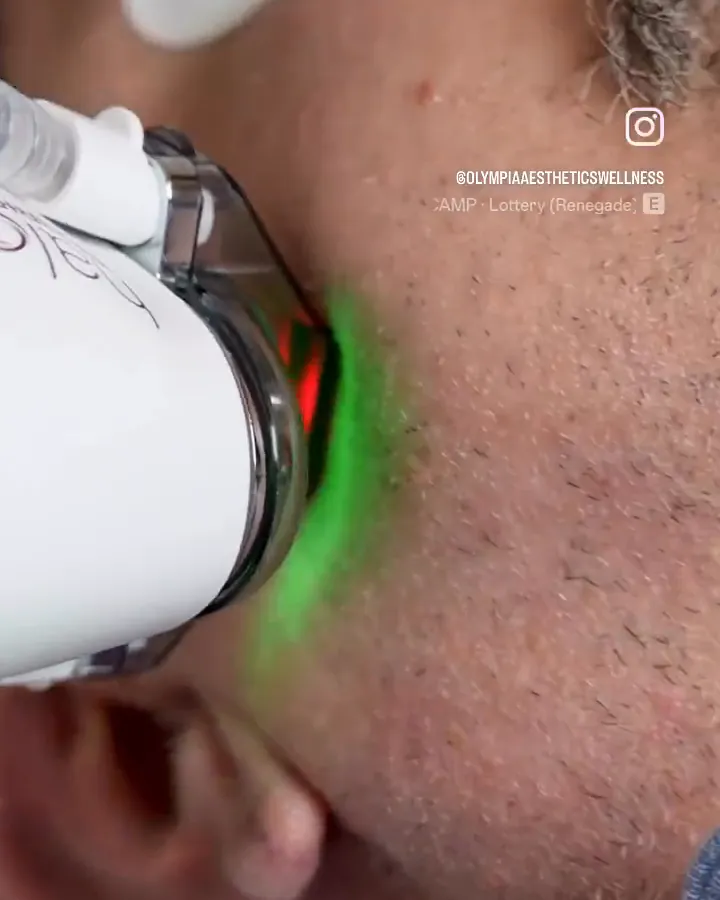
The handpiece moves across the skin a section at a time. Most people describe heat and a prickling feeling. Deeper settings feel more intense, but briefly.
The drive home
Expect heat and redness when you leave, more so after a deeper plan. You get home-care instructions, and driving yourself back to Tampa is not a problem.
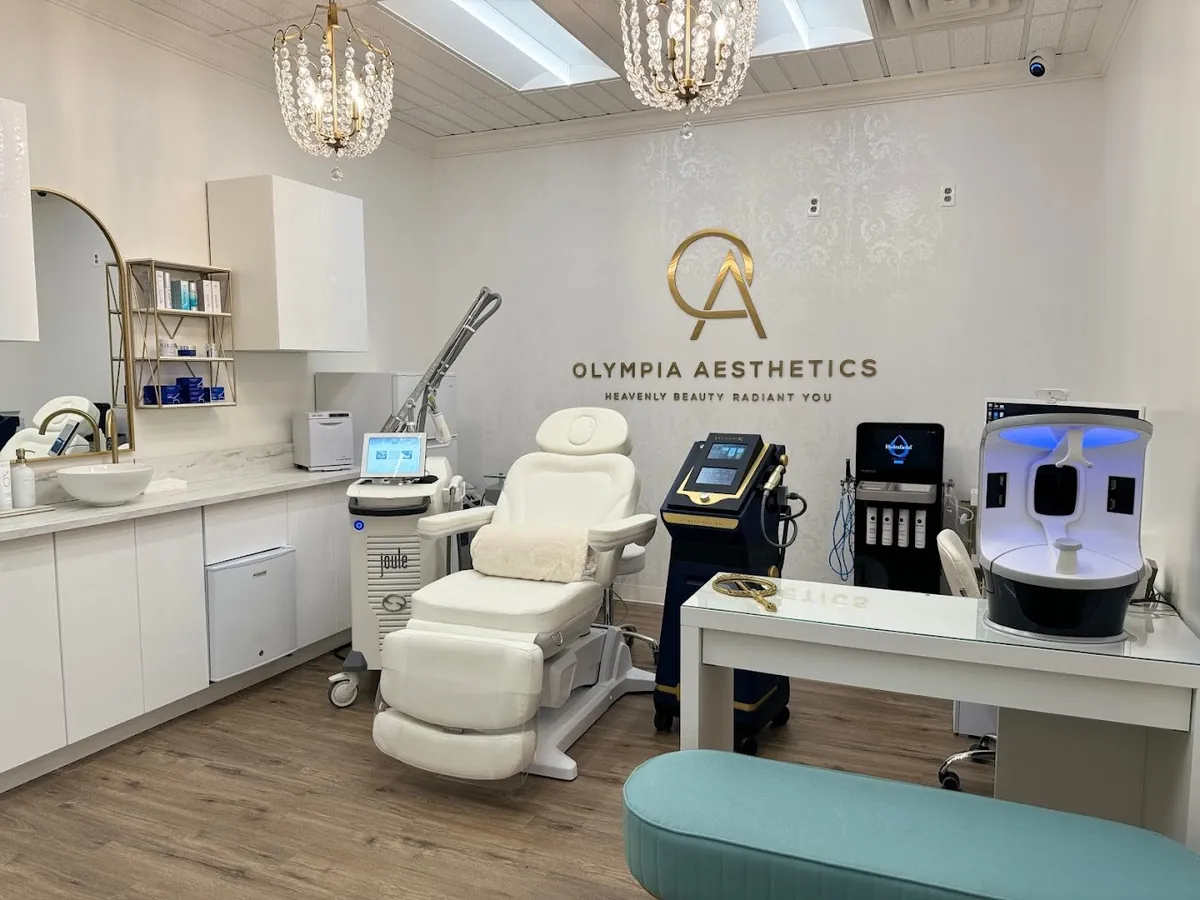
TRIBRID in our treatment room
Filmed at Olympia Aesthetics & Wellness in Palm Harbor and first shared on our Instagram. No sound.
Recovery depends on which dials were turned up
There is no single TRIBRID recovery. A lighter plan settles in a day or two. Deeper resurfacing takes several days, up to about a week.
- Treatment day
Flushed and warm
You leave red and warm whatever the settings were. Spend the evening in and keep the skin cool.
- Days 1 to 2
A lighter plan settles
Mild redness and warmth usually last one to two days. The 1927 nm wavelength is the MOXI wavelength, so a sandy feel and tiny dark specks can follow for a few days more.
- Several days
A deeper plan at its most visible
Expect redness and swelling, then peeling. Keep this stretch clear of meetings and dinners out, and let the skin shed by itself. Our main site has healing photos from day 1, day 3, day 5 and day 8.
- About a week
A deeper plan looks normal again
Redness, swelling and peeling have usually run their course. New skin burns easily, so sunscreen, a hat and shade matter more than usual.
- Days to months
Results
Change shows in days to weeks. Collagen keeps remodeling for several months, so lines and texture can keep improving after the recovery is forgotten.
This is general. Olympia gives you exact written instructions for your settings. If anything looks wrong while you heal, call the clinic that day.
Results, and when to expect them
Often one session is the whole plan, and some plans add a second six to twelve months later. The first photo was taken two weeks after one treatment. The second pairs TRIBRID with BBL HEROic, one month after one treatment.
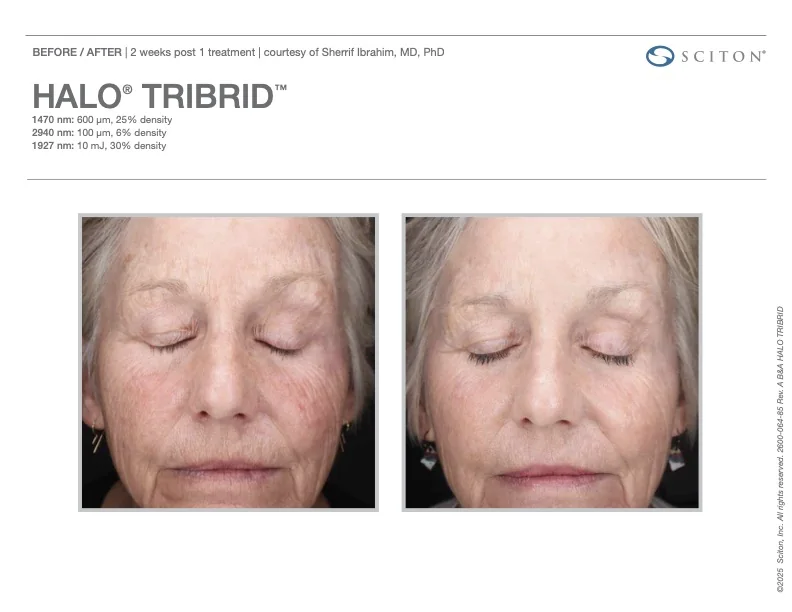
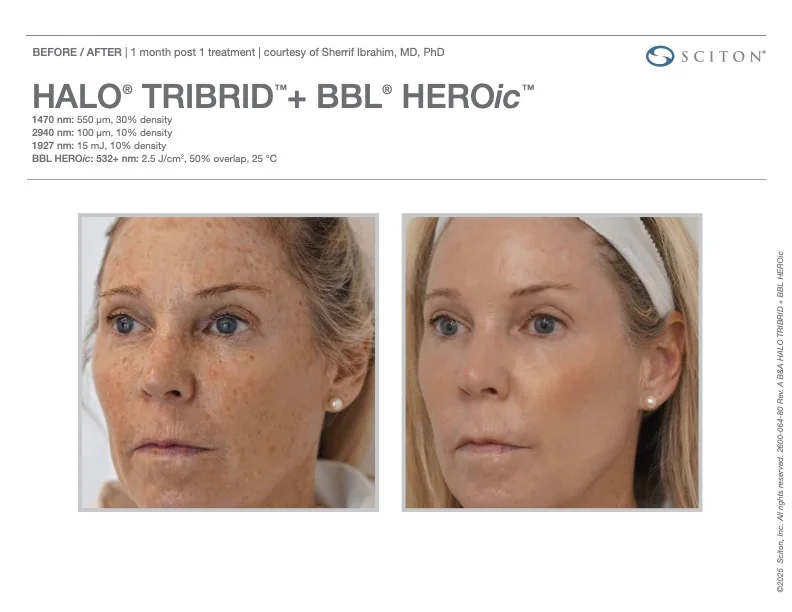
These are Sciton’s published clinical photos from other practices, shown to illustrate what the technology can do. They are not Olympia patients. Results vary from person to person.
Where TRIBRID sits in the Sciton family
Six treatments in one table. The other names link to their own guides.
| Treatment | What it is | Best for | Downtime | Sessions | Price |
|---|---|---|---|---|---|
| MOXI | Non-ablative fractional laser 1927 nm | Early sun damage, dull tone, a first laser | A day or two of pinkness | Three or more, a few weeks apart | From $650 per session |
| HALO | Hybrid fractional laser 1470 nm and 2940 nm | Sun damage, texture, fine lines | About a week, depending on depth | Often one, sometimes two | $1,650 per session |
| HALO TRIBRID | Triple-wavelength fractional laser 2940 nm, 1927 nm and 1470 nm | Tone, texture and lines in one visit | A day or two (light) to about a week (deep) | Often one | $2,550 full treatment |
| BBL HEROic | Broadband light (IPL family), not a laser Filtered visible and near-infrared light | Sun spots, redness, uneven tone | Little to none | A short series, several weeks apart | From $650 per session |
| ProFractional | Fractional erbium laser (ablative) 2940 nm Er:YAG | Acne scars, surgical scars, etched lines | 3 to 7 days, by depth | One, or a short series | From $1,200 per session |
| Contour TRL | Full-field erbium resurfacing laser (ablative) 2940 nm Er:YAG | Deep lines, advanced sun damage, scars | A week or more | Often one | Priced by depth and area |
Swipe sideways to see the whole table.
Look at TRIBRID’s downtime: a day or two at the light end, about a week at the deep end. That spread is the point of it. Most adjustable is not the same as strongest. For the deepest structural correction, Contour TRL goes further, and MOXI remains the usual upkeep between TRIBRID sessions.
Who sets the three dials

At this practice one person performs every laser treatment, TRIBRID included: Olympia Morris, PA-C. She runs the consultation, chooses the setting for each wavelength and holds the handpiece. Nothing is passed to a technician.
With three independent settings, judgment matters more than the machine. The practice is expert provider-led, with Dr. Oliver Morris as Medical Director.
- Olympia Morris, PA-CPhysician Assistant, owner and lead aesthetic provider. Certified by the National Commission on Certification of Physician Assistants (NCCPA).
- Dr. Oliver Morris, DOMedical Director. Board-certified in emergency medicine by the American Board of Emergency Medicine.
- 5.0 on Google36 reviews as of November 2026. Read them on Google Maps.
The drive from Tampa to Palm Harbor
The clinic is in Palm Harbor, across the bay in Pinellas County. It is near Tampa, not in it. From most Tampa neighborhoods the drive is roughly half an hour to 40 minutes without traffic.
Palm Harbor, FL 34684
(727) 274-1972
- Monday to Friday
- 10 am to 6 pm
- Saturday and Sunday
- 10 am to 2 pm
Inside the Sola Salon building at Coral Landings plaza (the Publix plaza), on the east side of US-19 just north of Tampa Road.
- Westchase14 miles, about 27 minWest through Oldsmar on Tampa Road, then north on US-19.
- Carrollwood20 miles, about 36 minHead west toward Oldsmar, pick up Tampa Road, then US-19 north.
- South Tampa and Hyde Park23 miles, about 40 minCross the Courtney Campbell Causeway and turn north on US-19 or McMullen Booth Road.
- Downtown Tampa24 miles, about 40 minCourtney Campbell Causeway, then north. The clinic is just past Tampa Road.
- Oldsmar8.5 miles, about 15 minTampa Road west to US-19, then a short hop north.
Distances and times are by road from the clinic without traffic. Allow extra at rush hour.
TRIBRID questions from Tampa patients
What does HALO TRIBRID cost near Tampa, and what is included?
A full HALO TRIBRID treatment at Olympia Aesthetics & Wellness in Palm Harbor is $2,550, described on the price list as the HALO and MOXI wavelengths in one session. FullFaceTox members get a one-time $550 off. For new patients who request a consultation through this site, a first laser treatment is 20 percent off. The two can be combined.
Is HALO TRIBRID just HALO and MOXI done on the same day?
Close, but not exactly. One handpiece delivers the two HALO wavelengths and the MOXI wavelength in one session, each set independently, and the surface wavelength can be set a little deeper than in classic HALO. For you, the practical difference is one visit and one recovery.
Does the third wavelength mean a longer recovery?
Not by itself. Recovery follows the settings, not the number of wavelengths. A lighter TRIBRID plan is red and warm for a day or two. Deeper resurfacing brings swelling and peeling as well, and takes several days, up to about a week.
How many HALO TRIBRID sessions do most people need?
Often one. Some plans add a second session six to twelve months later. Collagen keeps remodeling for several months, so it is worth seeing what the first session does before planning another.
I have already had HALO. Is TRIBRID worth it next time?
It depends on what is left. If texture improved and brown pigment still bothers you, the added 1927 nm wavelength is the reason to consider TRIBRID. If HALO gave you what you wanted, repeating it at $1,650 per face session is the simpler choice.
Is HALO TRIBRID suitable for deeper skin tones?
Sciton states that HALO TRIBRID can be used on Fitzpatrick skin types I to VI. That describes what the laser can be set to do. The main risk remains dark marks after any treatment that heats the skin, and a 2024 review of lasers for pigment in skin of color supports conservative settings for deeper tones. Whether TRIBRID or a gentler MOXI suits your skin is decided at a consultation.
How long is the whole trip from Tampa for a TRIBRID appointment?
Treatment takes 30 to 90 minutes after numbing, so allow a good part of a morning or afternoon. Without traffic, the clinic is about 14 miles and 27 minutes from Westchase, and about 24 miles and 40 minutes from downtown Tampa. You can drive yourself home.
More to read
Sources for this page
This page is written for patients by Olympia Aesthetics & Wellness. It is general information, not a diagnosis or a treatment plan. The studies and specifications below are where our factual claims come from.
- Sciton, Inc. HALO TRIBRID: published specifications. sciton.com/halo-tribrid
- Sciton, Inc. HALO hybrid fractional laser: published specifications. sciton.com/halo
- Sciton, Inc. MOXI: published specifications. sciton.com/moxi
- Waibel S, Pozner J, Robb C, Tanzi E. Hybrid fractional laser: a multi-center trial on the safety and efficacy for photorejuvenation. Journal of Drugs in Dermatology. 2018;17(11):1164-1168. pubmed.ncbi.nlm.nih.gov/30481954
- Brauer JA, McDaniel DH, Bloom BS, et al. Nonablative 1927 nm fractional resurfacing for the treatment of facial photopigmentation. Journal of Drugs in Dermatology. 2014;13(11):1317-1322. pubmed.ncbi.nlm.nih.gov/25607696
- Hsiao FC, Bock GN, Eisen DB. Recent advances in fractional laser resurfacing: new paradigm in optimal parameters and post-treatment wound care. Advances in Wound Care. 2012;1(5):207-212. pmc.ncbi.nlm.nih.gov/articles/PMC3839025Open access
- Trivedi MK, Yang FC, Cho BK. A review of laser and light therapy in melasma. International Journal of Women’s Dermatology. 2017;3(1):11-20. pmc.ncbi.nlm.nih.gov/articles/PMC5418955Open access
- Garg S, Vashisht KR, Garg D, et al. Advancements in laser therapies for dermal hyperpigmentation in skin of color: a comprehensive literature review and experience of sequential laser treatments in a cohort of 122 Indian patients. Journal of Clinical Medicine. 2024;13(7):2116. pmc.ncbi.nlm.nih.gov/articles/PMC11012689Open access
- Olympia Aesthetics & Wellness. Published price list. olympiaaesthetics.com/pricing